Before choosing a chain size or a drive, you need to know how hard the drive must pull. This estimate method shows which factors matter; the final calculation should always follow your chain supplier's method and ratings.
The Four Parts of Chain Pull
- Moving weight: chain, trolleys, carriers and products along the whole loop
- Rolling friction: a friction factor applied to the moving weight
- Inclines: the force needed to lift loaded carriers up rises
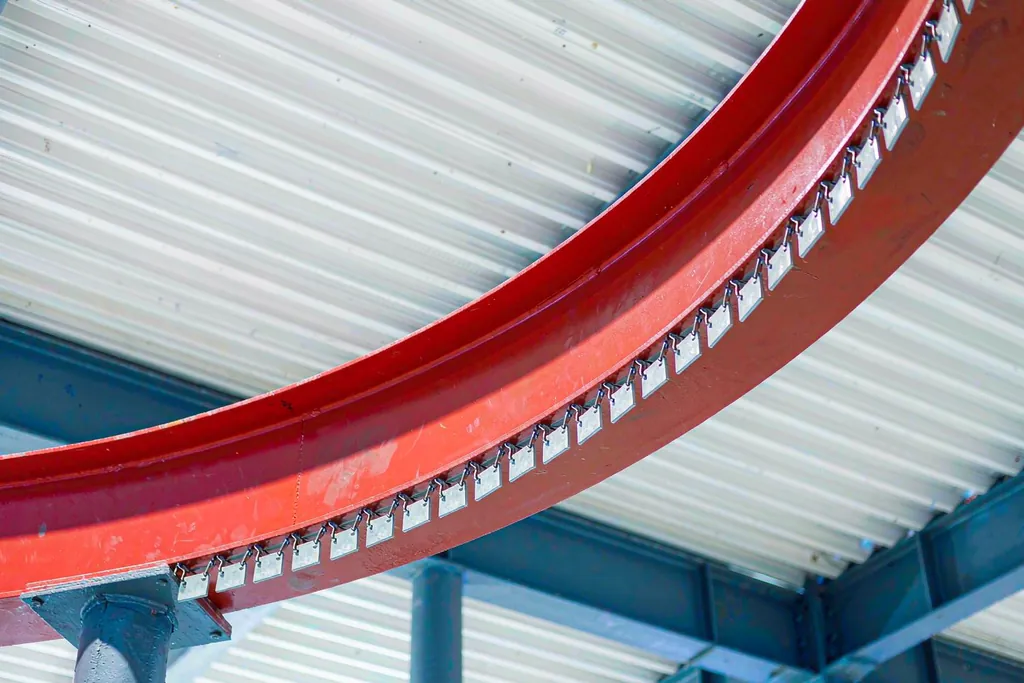
- Curves: each horizontal turn and vertical curve multiplies the tension
Pull ≈ [(moving weight × friction factor) + incline lift] × curve factors
Worked Example
Illustrative figures for a 200 m loop:
| Item | Value |
|---|---|
| Loop length | 200 m |
| Chain and trolleys | 8 kg/m |
| Carriers with product | 30 kg every 1 m |
| Friction factor (anti-friction trolleys) | 0.02 (illustrative) |
| Rises on the loaded side | 2 rises of 2 m |
| Horizontal 90° roller turns | 10, factor 1.02 each (illustrative) |
- Moving mass per metre: 8 + 30 = 38 kg/m. Over 200 m: 7,600 kg.
- Friction: 7,600 kg × 0.02 = 152 kg-force ≈ 1.49 kN.
- Incline lift (counting rises only, conservative): 38 kg/m × 2 m × 2 rises = 152 kg-force ≈ 1.49 kN.
- Curves: 1.0210 ≈ 1.22.
- Estimated pull: (1.49 + 1.49) kN × 1.22 ≈ 3.6 kN.
Compare the result, with the start-up and safety factors your supplier recommends, against the allowable working load of the chain. If it is close, consider a larger chain, a second drive or a layout with fewer bends.
What Changes the Result Most
| Factor | Effect |
|---|---|
| Product weight and carrier pitch | Directly scales moving weight |
| Lubrication and bearing condition | Raises the friction factor as it deteriorates |
| Oven temperature | Can raise friction and changes chain length |
| Number of turns | Multiplies tension |
| Long rises | Adds lift force |
Practical Checks
- Calculate for the heaviest product mix, not the average
- Locate the drive where tension is highest, usually after the longest loaded run
- Consider multiple drives on long loops
- Size the take-up for elongation and thermal growth
- Re-check pull after any layout or load change